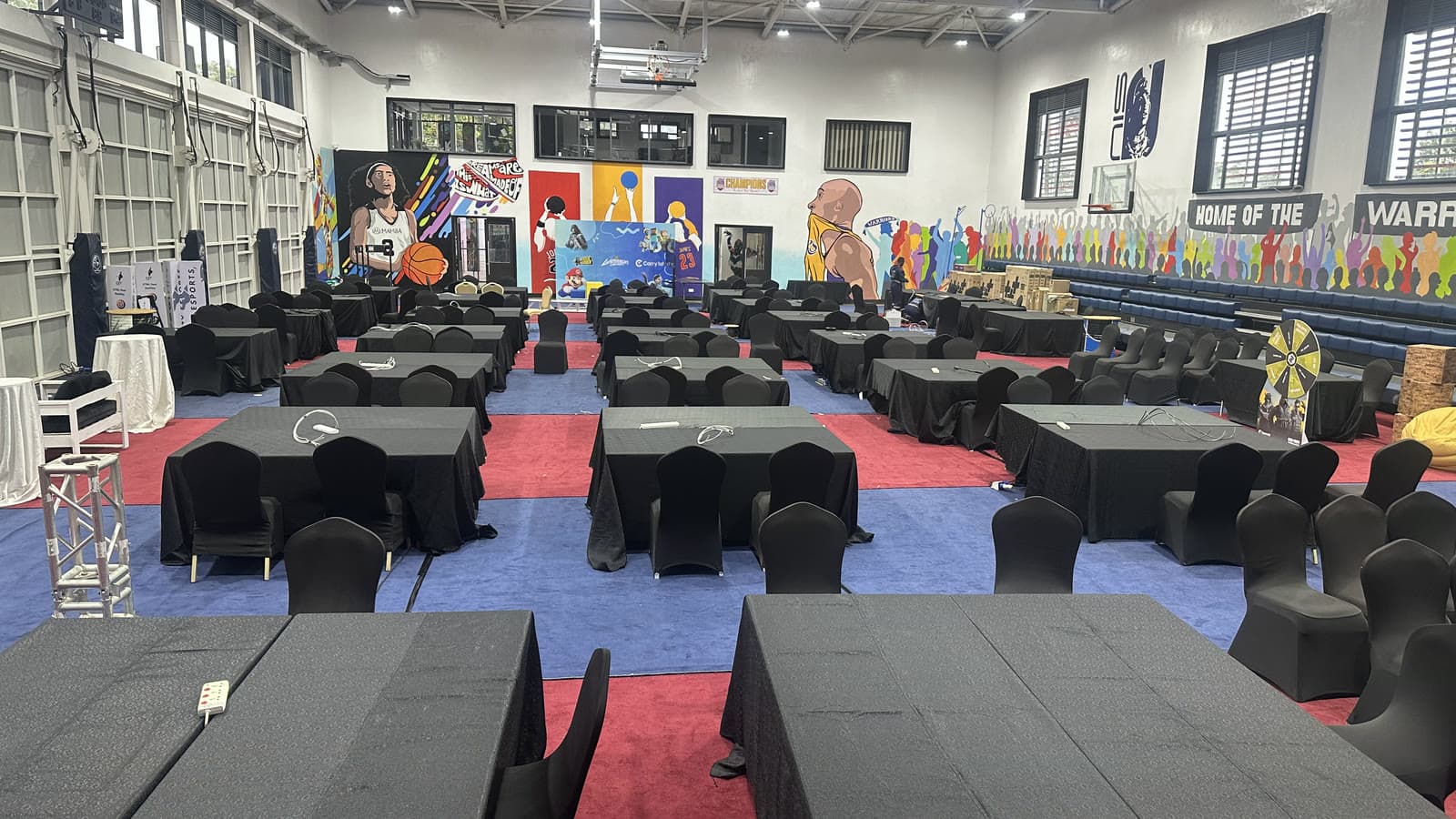
I've run a few LAN events over the years. Some have been more successful than others, but every one of them has taught me something.
I've hosted LANs in campus hostels, hosted them at my own place, and worked with other companies to put together and run larger events.
After doing it a few times, I've started to notice that there are a few things I always come back to when planning a LAN.
- Keep your regulars entertained.
- Make it approachable for newcomers.
- Have a lot of food.
- Have fast internet, or at least a plan for it.
- Keep the vibes going.
These aren't really rules. They're just things I've learned from actually having to run the thing and deal with whatever goes wrong on the day.
Keep your regulars entertained
Your regulars are probably one of the most important parts of your LAN community.
While working with Movie Jabber on Otamatsuri x LANarchy 2025, LANarchy 2026 and Otamatsuri x LANarchy 2026, as well as running my own home-based LANs, I started noticing something.
There are people who just keep showing up.
You start recognising the same faces at different events. They know what they're getting themselves into, they know some of the other attendees, and they're usually there to have a good time regardless of what is happening.
They're also usually a vibe.
And the interesting part is that when these regulars show up, they often don't come alone. A familiar face comes back, and suddenly there's a new person with them who has never attended before.
I don't have some fancy dataset proving this is how every LAN community grows. It's just something I've repeatedly observed across the events I've been involved with.
But it did make me think about retention differently.
It's easy to focus on getting new people through the door. But if the people who already enjoy your events keep coming back, they become part of the experience themselves.
Give them something to look forward to.
Maybe it's a different tournament. Maybe it's a new game. Maybe it's a side activity they didn't have last time. It doesn't always have to be something massive.
Sometimes keeping the regulars entertained is simply making sure the next LAN doesn't feel exactly like the last one.
Make it approachable to newcomers
The other side of that is making sure someone can walk into your LAN for the first time and actually feel comfortable.
Not everyone is going to know everyone else.
Not everyone is going to be playing the main game.
And not everyone is going to arrive with a group of ten friends.
You don't want your LAN to feel like a private club where everyone already knows each other and the new guy is just sitting in the corner wondering what is happening.
This is another reason I think the regulars are so important.
A good regular can end up being the person who pulls a newcomer into a game, explains what's happening, or just starts talking to them.
You also want activities that don't require someone to already be invested in whatever the main competitive game is.
If someone doesn't want to play the tournament, there should still be something for them to do.
The goal is pretty simple:
If they enjoy themselves, there's a decent chance they come back.
And maybe next time, they bring someone with them.
A lot of food
This one is low-key a necessity.
If you're hosting a LAN for several hours, people are going to get hungry.
Very hungry.
For my homegrown LAN events, I usually provide a ridiculous amount of food. And when I say a lot, I mean a lot.
Chicken fried rice. Beef stew. Plain rice. A proper spread with a selection of things for people to eat.
I usually end up with enough leftovers to last me a week's worth of meal prep.
That's how much food is left after some of these events.
The lads enjoy it, which is the important part.
The problem is that my wallet does not.
I've definitely put myself in the negatives trying to make sure everyone is fed.
At the time, I'm usually thinking, "It's fine, people are having a good time."
Then the event ends and I look at what I've spent and realise that food probably needs to become an actual line item in the event budget.
So if I host another LAN, food is going into my running costs.
If you're not providing the food yourself, that's completely fine. Just have some way for people to get food without having to leave the event for an hour.
Have a nearby food vendor.
Have delivery options.
Have someone selling food at the venue.
Whatever works.
Just remember that gamers apparently require an unreasonable amount of food when they're sitting in one room for twelve hours.
Fast internet, or a game cache
Internet is another one of those things you don't really appreciate until it becomes a problem.
When you're hosting a LAN, everyone has games installed, everyone has updates, someone inevitably forgot to download something, and suddenly you've got a room full of computers trying to pull hundreds of gigabytes from the internet.
My first LAN didn't have particularly fast internet.
What I did have was LANCache.
LANCache allowed me to cache game downloads and updates locally. Instead of every machine repeatedly downloading the same files from the internet, cached content could be served locally across the LAN.
That meant I could save external bandwidth for the things that actually needed the internet.
This is particularly useful when you're dealing with online games where you want the connection to remain stable.
One important distinction, though: LANCache isn't going to magically lower everyone's ping. It's primarily useful for reducing repeated internet downloads and bandwidth usage.
Since that first LAN, I've gotten a better relationship with my ISP and can arrange a temporary internet speed boost for LAN days.
That has made things considerably easier.
But I'd still recommend having a caching strategy if you're running a larger LAN.
Because there is nothing more painful than watching 20 people simultaneously download a 60 GB game update while everyone else is trying to play.
And please, test your setup before the event.
Don't wait until people arrive to discover that your cache isn't caching anything.
Keep the vibes going
This is probably the easiest thing to forget when you're focused on the technical side of the event.
When you're organising a LAN, it's very easy to get obsessed with the important stuff.
- Do we have enough power?
- Is the network working?
- Are the PCs connected?
- Is the internet working?
- Is everyone in the right lobby?
- Who's running the tournament?
- Where are the cables?
- Who took the extension?
- Why is someone's PC downloading a 100 GB update?
All important questions.
But eventually you need to remember that people aren't just there to stare at a monitor for twelve hours.
Keep the vibes going.
Have card games.
Have side quests.
Play some lively music.
Have random little competitions.
Have things people can do between matches.
Let people get away from their PCs for a bit without feeling like they're missing the entire event.
Some of the best moments at a LAN aren't necessarily the big tournament moments.
Sometimes it's a group of people playing cards at 3 AM.
Sometimes it's someone challenging another person to something completely unrelated to the main event.
Sometimes it's everyone laughing at something stupid that happened five minutes ago.
Those moments are what make the event memorable.
The games are the reason people might initially come.
The people and the atmosphere are often what make them want to come back.
So, what actually makes a good LAN?
After hosting LANs in campus hostels, at home, and alongside other event organisers, I've realised that the technical side is only one part of the equation.
You need the network.
You need the games.
You need enough power.
You need somewhere for everyone to sit.
You need internet.
You need food.
But you also need a reason for people to actually enjoy being there.
For me, that comes down to five things:
- Keep your regulars entertained.
- Make newcomers feel welcome.
- Feed people.
- Have a plan for your internet.
- And keep the vibes going.
The more LANs I do, the more I realise that I'm not really trying to build a room full of people playing games.
I'm trying to build a place people want to come back to.
And if the same people keep showing up, bringing their friends, and making the room feel alive, I think that's probably a pretty good sign that you're doing something right.